

-
About Their Next Move Towards 2027 Elections
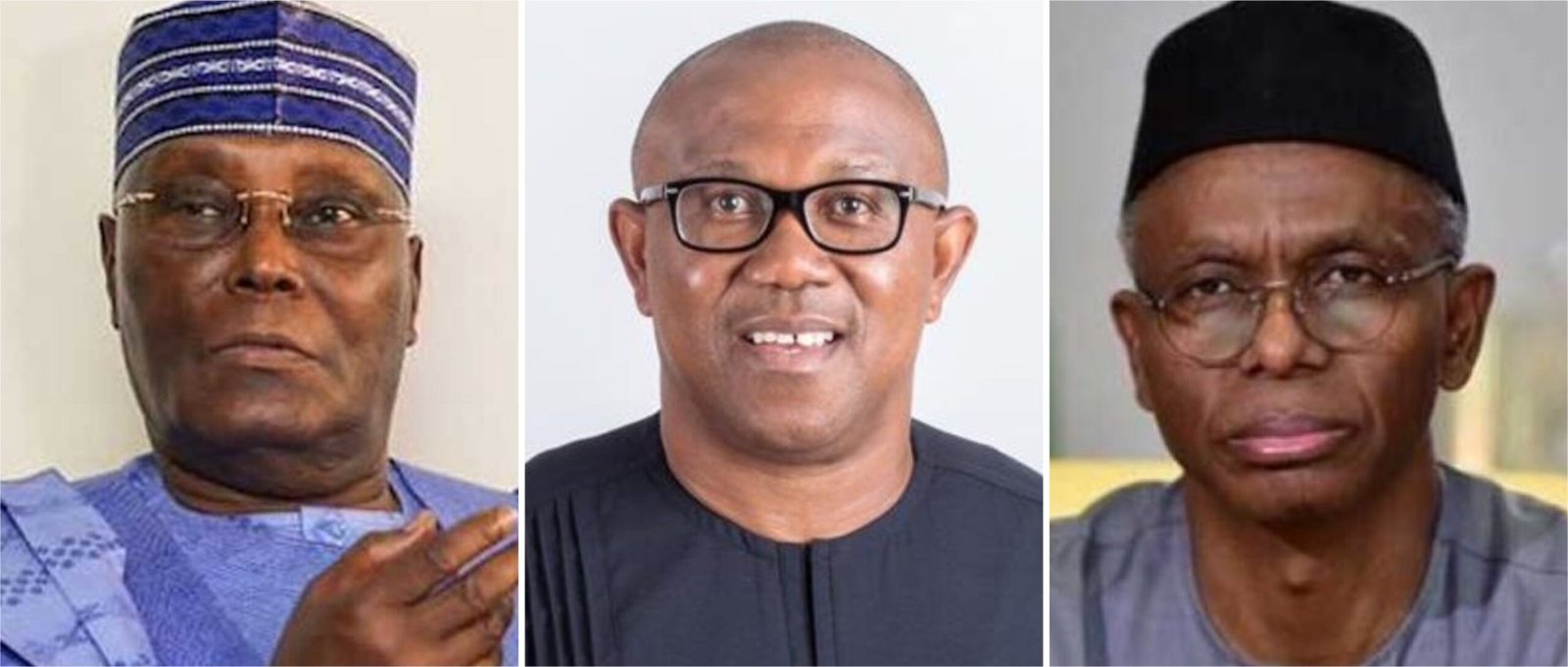
Are you one of those who have been wondering why the leaders of the Coalition Movement, Alhaji Atiku Abubakar, Peter Obi & Mallam El-Rufai have been quiet about their next move towards 2027.
If you are lets tell you the reason.
What has made the situation worrisome is the fact that although Atiku has left the PDP he hasn’t joined the ADC. The same with Peter Obi who though is a member of the Coalition insists that he is still in the Labour Party. As for Mallam El-Rufai, he is not saying anything.
Suddenly the coalition leaders have been quiet about their move.
What do they have up their sleeves?
We can tell you.
We hear that the coalition leaders are thinking of possibly leaving the ADC for another new party which INEC is about to register. Last week, Independent National Electoral Commission (INEC) announced that 8 of the 14 associations seeking registration as political parties have successfully completed the documentation stage of the process.
In a statement last Thursday, the National Commissioner and Chairman of the Information and Voter Education Committee, Sam Olumekun, said the eight associations met the October 18 deadline for uploading all required information and documents on the INEC portal.
“As of Saturday, 19th October 2025, eight out of the 14 pre-qualified associations successfully completed the upload of all necessary information and documentation,” the statement read.
The groups that scaled through include the All Democratic Alliance (ADA), Citizens Democratic Alliance (CDA), Abundance Social Party (ASP), African Alliance Party (AAP), Democratic Leadership Alliance (DLA), Green Future Party (GFP), National Democratic Party (NDP), and Peoples Freedom Party (PFP).
Olumekun said the next phase would involve a detailed assessment and verification of the information and documents submitted by each association to ensure compliance with the provisions of the 1999 Constitution (as amended), the Electoral Act 2022, and INEC’s Regulations and Guidelines for Political Parties (2022).
He added that the Commission remains committed to inclusivity, transparency, and the deepening of Nigeria’s democratic culture. INEC had earlier, on September 11, announced that 14 associations were pre-qualified for the final stage of the registration process, following a briefing with their representatives on September 17.
The completion of this documentation phase means the eight successful groups will now face verification visits and final scrutiny by INEC before the commission decides whether to issue them certificates of registration as fully recognised political parties.
The ADA had been considered an alternative platform for the opposition coalition that eventually adopted the African Democratic Congress (ADC) as its political base. At the time, some coalition leaders were believed to have held back from formally joining the ADC, reportedly hoping that INEC would approve ADA’s registration as a fresh political party to serve as a unified vehicle for the coalition.
However, the coalition-led ADC later clarified that it had concluded all matters relating to ADA. The coalition’s spokesman, Bolaji Abdullahi, said that, “The Coalition has rested everything concerning the ADA. That means, they are not interested in the registration or otherwise of the association.” But there are those who believe that Atiku and Co have their eyes on yet another political party.
Many don’t know that Alhaji Atiku Abubakar is an incurable optimist. Like most politicians, he doesn’t love giving up so easily. Despite all the wave of decamping of PDP governors to APC one after the other, Atiku is not bothered. Its a seasoned politician, he does believe that the decamping of governors can lead to automatic votes for Pres. Tinubu and the APC.
He feels if the coalition members follow his game plan, they will defeat Pres. Tinubu in forthcoming 2027 elections. Atiku’s strategy is simple: Let all the opposition leaders come together under a new party and contest against Tinubu. Like Atiku, many in the opposition camp have come to the realisation that only one candidate can’t defeat Tinubu.
His plan is to run for Presidency with Peter Obi. He sees that joker as the sure-fire solution to victory.
But there is a problem. Peter Obi is reluctant to be running mate to Atiku. He also wants to run for Presidency. Atiku and his camp believe that only a Northern Muslim candidate like Atiku running with a Southern Christian like Peter Obi can defeat Tinubu.
Dele Momodu echoed that view a few days back that coalition leaders should back a Northern candidate.
But the Obidient Movement has insisted that Peter Obi will not play a 2nd fiddle to anyone.
Atiku actually believes his strategy is the best for now. He says it is borne out of serious strategic thinking.
He also believes that of all the political players on the scene right now he is the most experienced.
Don’t forget that he has been at it since 1993 and he has survived the tupsy-turvy nature of politics in Nigeria.
Alhaji Atiku Abubakar served as the Vice President from 1999 to 2007 during the presidency of Olusegun Obasanjo. He ran for Adamawa governorship in 1990 and 1996 unsuccessfully, but won in 1998. Before he was sworn in, he was selected as running mate to former military leader, Olusegun Obasanjo, during the 1999 presidential election and was re-elected in 2003.
It is on record Atiku Abubakar ran unsuccessfully for President 6 times namely in 1993, 2007, 2011, 2015, 2019, and 2023. And he hopes to run again in 2027. He ran in the Social Democratic Party presidential primaries in 1993, but lost to Chief Moshood Abiola and Amb. Baba Gana Kingibe. He was a presidential candidate of the Action Congress in the 2007 presidential election coming in third to late Umaru Yar’Adua of the PDP and Muhammadu Buhari of the ANPP. He contested the presidential primaries of the People’s Democratic Party during the 2011 presidential election losing to incumbent President Goodluck Jonathan.
In 2014, he joined the All Progressives Congress ahead of the 2015 presidential election and contested the presidential primaries losing to Muhammadu Buhari. In 2017, he returned to the Peoples Democratic Party and was the party presidential candidate during the 2019 presidential election, again losing to incumbent President Muhammadu Buhari.
In May 2022, he was chosen as the Peoples Democratic Party presidential candidate again, this time for the 2023 general election after he defeated Nyesom Wike, the former Governor of Rivers State, in the primaries. He came in second in the general election, being defeated by Bola Tinubu, though Abubakar joined other opposition candidates in demanding a revote.
