

-
During Election Season
Whenever Nigeria approaches another election season, one familiar development often attracts public attention: the movement of influential Muslim politicians to Saudi Arabia to perform Umrah, the lesser Hajj. From presidential aspirants and serving governors to senators, political godfathers and wealthy business leaders, Mecca has continued to attract some of the country’s most influential personalities, particularly during Ramadan.
For many of these politicians, the journey is more than an ordinary religious trip. It represents an opportunity to disconnect temporarily from the pressures of political life, seek Allah’s guidance, pray for their ambitions, ask for forgiveness and commit their future into the hands of their Creator.
But there is another interesting dimension to this practice. Mecca has, over the years, become a meeting point for influential Nigerians, providing opportunities for political consultations, relationship-building and informal discussions among people who ordinarily occupy different political camps.
This explains why visits to the Holy Land by prominent Nigerian politicians often attract attention, particularly when they coincide with preparations for general elections.
The recent Umrah journey of President Bola Ahmed Tinubu has once again brought the subject into the spotlight, generating controversy over the religious and political implications of such visits.
So, why do many Nigerian politicians consider it important to visit Mecca before elections? Is it simply about seeking divine intervention, or does the pilgrimage also offer political advantages?
A look at Nigeria’s political history, Islamic traditions and the activities of past and present leaders provides an interesting insight.
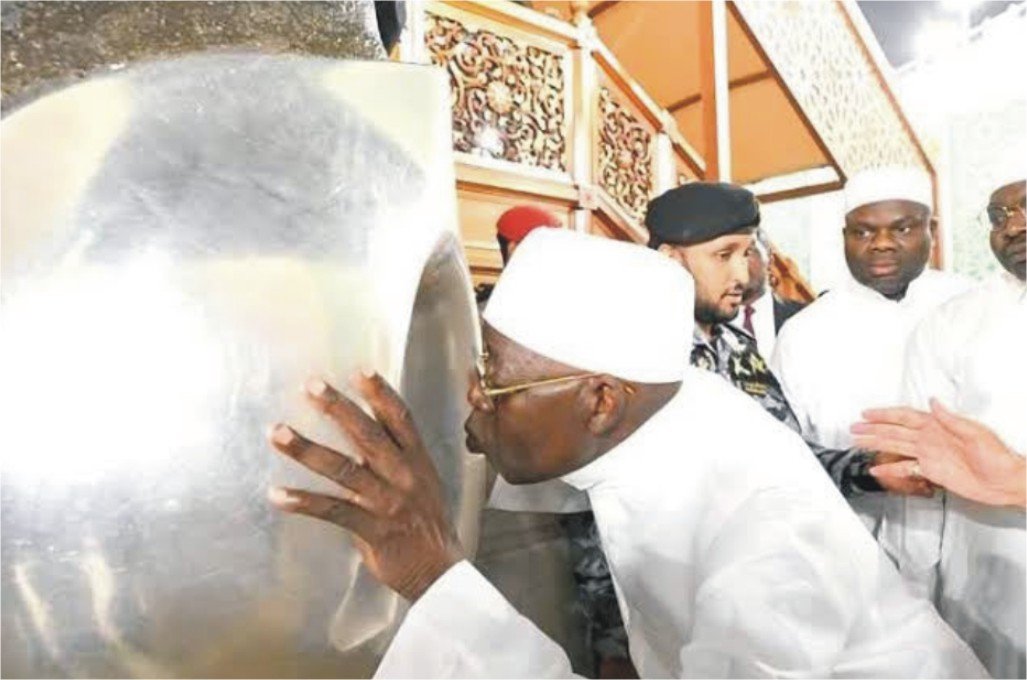
President Bola Ahmed Tinubu’s recent visit to Saudi Arabia to perform Umrah has generated considerable public discussion, particularly because it comes as political activities gradually gather momentum ahead of the 2027 general elections.
The President’s journey, which began on October 29, 2026, was presented by the Presidency as an opportunity for spiritual reflection, devotion and prayers for Nigeria’s peace, unity, stability and progress.
However, the trip quickly became a subject of political debate.
Former Vice-President Atiku Abubakar’s camp questioned the circumstances surrounding the visit. Atiku’s spokesperson, Phrank Shaibu, reportedly described it as a political Umrah, questioning whether the President’s pilgrimage was primarily a spiritual exercise or an attempt to strengthen his political image ahead of another election.
The Presidency rejected suggestions that the journey was politically motivated, maintaining that Tinubu’s visit was a genuine religious exercise.
Interestingly, the controversy has also brought attention to Tinubu’s religious identity and the significance of his public appearance performing Islamic rites in Mecca.
For some observers, the pilgrimage represents an opportunity for the President to reaffirm his Muslim identity and demonstrate his connection with the Islamic faith, particularly amid political conversations surrounding religion in northern Nigeria.
But Tinubu’s latest visit is not an isolated development. His relationship with Umrah and the political significance of such journeys can be traced to the build-up to the 2023 presidential election.
One of the most interesting examples of the relationship between Umrah and Nigerian politics occurred in April 2022, when several influential Nigerian politicians and business leaders travelled to Saudi Arabia during Ramadan.
Among the prominent personalities reported to have been in Mecca during the period were Bola Ahmed Tinubu, former Vice-President Atiku Abubakar, former EFCC Chairman Nuhu Ribadu, Africa’s richest man Aliko Dangote and billionaire businessman Abdul Samad Rabiu.
The gathering attracted considerable attention because it happened barely a month before the presidential primaries of the major political parties.
A THISDAY report published on April 28, 2022, highlighted the presence of these influential personalities in Saudi Arabia for prayers and networking.
Although the individuals had their separate religious reasons for undertaking the pilgrimage, the gathering also provided opportunities for conversations about Nigeria’s political future.
Think about it: influential politicians, former public office holders and some of the country’s wealthiest businessmen were all in the same city at a critical period in the country’s political calendar.
For politicians, such encounters can be valuable. They provide opportunities to reconnect with old allies, exchange ideas, consult experienced political figures and discuss matters that may influence their political calculations.
This is one reason Mecca has continued to occupy an interesting position in Nigeria’s political conversations.
The relationship between pilgrimage and political leadership in Nigeria is not a new phenomenon. It has a history stretching back to the colonial era and the years immediately preceding independence.
One of the most prominent political figures associated with this tradition was the late Sir Ahmadu Bello, the Sardauna of Sokoto and Premier of Northern Nigeria.
Ahmadu Bello was not only a leading politician but also an influential Muslim leader whose religious activities formed an important part of his public identity.
Historical references showed the relationship between Ahmadu Bello’s pilgrimages and the politics of Northern Nigeria between 1954 and 1963.
He reportedly performed his first Hajj in 1955 and made the pilgrimage almost every year until his death in 1966.
Interestingly, his journeys were not always solitary religious exercises. He often travelled with political associates and influential personalities.
His administration also introduced reforms to facilitate pilgrimage, including improvements in air transportation for Nigerian pilgrims.
These developments helped make pilgrimage an important symbol of religious identity, leadership and political influence in Northern Nigeria.
The experience established an important historical connection between Nigerian political leadership and the Holy Land, one that successive generations of politicians have continued to embrace.
Perhaps the most obvious reason many Muslim politicians travel to Mecca before elections is their desire to seek divine guidance and intervention.
In Islam, prayer and supplication occupy an important position in the life of every believer.
For a politician preparing for an election, the stakes can be enormous. The outcome could determine whether the individual becomes a president, governor, senator, member of parliament or returns to private life.
Some politicians therefore consider Umrah an opportunity to seek Allah’s assistance, wisdom, protection and forgiveness before embarking on another political journey.
They pray for success, but they may also pray for the ability to govern responsibly, make sound decisions, overcome challenges and fulfil the responsibilities of public office.
For many of them, there is a strong belief that no matter how much political preparation, financial resources or human support an individual possesses, ultimate success remains in the hands of Allah.
This explains why some politicians make it a personal commitment to visit Mecca before major political decisions.
They see the journey as an opportunity to surrender their ambitions to Allah and seek His guidance.
Another interesting dimension of the pilgrimage is the opportunity it provides for influential Nigerians to interact outside their usual political environments.
During Ramadan, Mecca attracts wealthy businessmen, politicians, traditional rulers, Islamic scholars, former public office holders and other prominent personalities from across the world.
For Nigerian politicians, this creates opportunities to meet individuals whose influence extends beyond their immediate political constituencies.
A former governor may meet a serving senator. A presidential aspirant may encounter an influential businessman. Political associates who have not spoken for months may find themselves sharing the same religious environment.
Such encounters can help strengthen relationships, encourage reconciliation and create opportunities for conversations about national issues.
It is also possible for politicians to use the opportunity to seek advice from experienced political figures or discuss future political arrangements.
The interesting thing is that these conversations do not necessarily take place in formal meeting rooms or party secretariats. They may happen during meals, visits, social gatherings or informal encounters around the pilgrimage.
This is why some observers regard Mecca as an important meeting point for Nigeria’s political and business elite.
However, it is important to distinguish documented meetings from speculation about political agreements. The fact that politicians meet during Umrah does not automatically mean they are negotiating political positions or electoral alliances.
-Jamiu Abubakar
