


For more than a decade and a half, night has fallen too heavily on Abigi, a historic coastal town in Ogun State. When the sun sets, homes, streets, clinics, shops and hotels slip into near total darkness, broken only by the flicker of candles, kerosene lanterns, phone torchlights and the constant hum of small generators. For the people of Abigi, darkness is no longer a temporary inconvenience. It has become a way of life, one they say has been forced on them by years of neglect, broken promises and failed interventions.
When a City People reporter visited Abigi some days ago, what stood out immediately was not just the absence of electricity but how deeply the lack of power has reshaped everyday living. From the palace to the health centre, from small roadside shops to modest hotels, the same story echoed everywhere. Abigi has been without public electricity for about fifteen years, and residents say they feel forgotten by those meant to serve them.
Abigi is one of the oldest towns in Ogun State, with a rich history tied to trade, fishing and commerce along the coastal corridor. Located in Ogun Waterside Local Government Area of Ogun State, the town has long served as a link between parts of Ogun and Lagos States. Traditionally known for fishing, boat making and vibrant local markets, Abigi once attracted traders, visitors and investors who came to do business by the waterside. Elders recall a time when the town was lively at night, when homes were lit, businesses thrived after sunset and children studied under electric bulbs rather than smoky lamps.
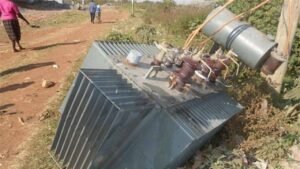
Today, that memory feels distant. Streets that should be buzzing with activity go quiet early. Shops close once daylight fades. Young people complain that opportunities have dried up, not because Abigi lacks potential, but because modern life without electricity is almost impossible to sustain.
Speaking on the issue, the traditional ruler of the town, the Ojotumoro, Ilufemiloye of Abigiland, Oba Olusegun Ogunye, traced the origin of the prolonged blackout to structural and administrative problems that were never fully resolved.
According to the monarch, Abigi’s electricity supply was never directly connected within the town. “Where the light is connected is called Ogbere, from Ijebu East,” he explained. “So the distance, whenever there is an accident or any vehicle hits the poles, it becomes an issue.”
He said because the power line feeding Abigi comes from far outside the town, even minor incidents often lead to major disruptions. “For them to replace anything takes a very long time,” the king said. “As a result, there was vandalisation. The criminals got in to play.”
Oba Ogunye explained that once vandals realised the line was poorly monitored, they took advantage of it. “They vandalised and stole quite a lot of things,” he said. “They removed wires, they removed cables, they removed whatever you can think about. And that was it.”
Since then, according to the monarch, Abigi has remained in darkness despite repeated appeals to different levels of government. “We have been approaching government, state government, federal, rural electrification and so on,” he said. “It’s been promise and fail, promise and fail. So that is it.”
The king revealed that even when there appeared to be progress on paper, nothing changed on the ground. “I was told that the funds, because there has been an approval according to government, are yet to be released,” he said. “I spoke with the Director General some days ago and he said he has not gotten the funds approval. So it’s a sad story that we have been like that.”
He added that the community has not been completely idle in the face of abandonment. “If you go through the place, you will see where we are trying to put in solar for the community,” Oba Ogunye said. “For our big community, we are making efforts. But it’s a sad story because when we want to develop our community, that’s where we find ourselves today.”
Putting the timeline in perspective, the monarch said the darkness predates his reign. “I have been nine years on the throne, and about five years before then,” he explained. “Put it at fifteen years.”
Asked whether successive administrations had attempted to address the issue, the king was blunt. “Nothing has been done,” he said. “This administration would have made an attempt, but nothing has been done.”
Across Abigi, residents share similar frustrations. Many say the absence of electricity has crippled businesses and pushed young people to leave the town in search of better opportunities elsewhere.
A middle-aged trader at the main market, who sells frozen fish, said the blackout destroyed her livelihood. “Before, we used freezers,” she said. “Now, everything is generator or ice block. Fuel is expensive. Sometimes the fish spoils. We are suffering.”
A young phone repairer said he has considered relocating several times. “Electricity is our life,” he said. “Without light, how do you charge phones, test gadgets or work at night? We feel abandoned. It’s like Abigi does not exist to the government.”
At the Abigi health centre, the impact of darkness is even more alarming. Health workers told City People that providing care without stable electricity has been a constant struggle.
A nurse at the facility said, “At night, when there is an emergency, we use torchlight or generator. Sometimes the generator fails, or there is no fuel. This is a health centre. Light is not a luxury for us, it is a necessity.”
Another health worker added, “Vaccines, drugs, deliveries, emergencies, everything depends on electricity. Solar helps a bit, but it cannot sustain us. We need government power urgently.”
Hoteliers and business owners paint an equally grim picture. One hotel manager said electricity bills were once predictable, but now fuel costs have become overwhelming. “We run generator almost twenty-four hours,” he said. “Fuel prices keep going up. Guests complain about noise, about heat, about lack of steady light. Some don’t even come here again.”
A restaurant owner echoed the same concern. “You cannot keep food fresh without light,” she said. “Generator cannot do everything. Solar is not enough. We are tired.”
Beyond economic hardship, residents say the blackout has affected safety and social life. Streets are dark at night, increasing fear of crime. Children struggle to read. Community events end early. According to many residents, Abigi feels cut off from modern Nigeria.
An elderly resident summed up the mood of the town. “We hear about development on radio and television,” he said. “But here, nothing. Fifteen years without light is not a joke. We feel forgotten.”
Solar panels, which have become common in many homes, are not the solution residents hoped for. While some households have managed to install small solar systems, many say they are expensive and limited. “Solar cannot power everything,” a shop owner explained. “You still need generator. And generator needs fuel. How long can people survive like this?”
Residents insist that Abigi does not lack importance or relevance. With its strategic location and long history of commerce, they believe the town deserves basic infrastructure. Many argue that electricity would revive businesses, improve healthcare, attract investors and reduce youth migration.
As City People observed during its visit, Abigi is not asking for luxury, just the basics. The people want light in their homes, clinics and streets. They want to feel included in the development of Ogun State.
For now, the town remains in darkness, waiting for promises to turn into action. As one resident put it quietly, “We are not asking for miracles. We just want to see light again.”
By Benprince Ezeh
08068599879
